Sunday, March 8, 2015

Artist Books I've Made (part 1 of 3)

One of the most enchanting aspects of the artist's book--at least from my perspective--is the complete control that the artist/author has over all aspects of the bookmaking process. Sure, an artist's book is written and illustrated by the author--but the author can also control the book materials (paper, ink, font, cover, binding), book presentation, and handmade details (like hand-coloring, lettering, or other personal, one-of-a-kind touches). So when I first decided that I would move on from merely admiring others' artists' books to creating my own, I wanted to explore all of these various elements of control. But, of course, I also had no idea what I was doing. So--project Artist Book #1 began ambitiously, but experimentally.

Here, you can see a charcoal drawing (left), followed
by gesture eight (middle), and a photograph (right)
I decided my first book would be a version of a poem I'd written some years previously, entitled "Gestures of a Rose." This poem, in eleven parts, functioned as a kind of bouquet of fragments--one short of a dozen--each of which I thought of as expressive of the logic behind the "gesture" of giving flowers to someone. In text-only form, the poem was broken into numbered sections; when translated to artist's book, I decided to print each gesture alone on a page. Between each textual gesture, I included other "gestures"--prints of artwork (photography or charcoal drawings) that I had done.

I printed most of the text and artwork on regular white paper; however, I experimented a bit with some translucent printing at the book's beginning and ending.
the title page is printed on translucent
paper, through which you can see
the photograph below
at the book's close, a cropped version
of the cover photo is printed
on translucent paper


I wanted to learn to do a sewn binding for this first book, and so I chose what I thought would be an easy beginner's bind--a Japanese stab binding. A quick online search will illuminate tons of stab bindings in crazy intricate patterns; I, however, chose the most simplistic 4-hole version. Not totally elegant, but it sufficed!


 This binding method is pretty flexible, as you can cut two separate covers and bind together whatever amount of paper/paper varieties you want. My version was pretty slim, with only a bit of paper variety--but you could do much more!

I used red handmade paper (though not handmade by me!) as a liner
between the covers and the book proper--protective and pretty!

Though thus far, the books I made were pretty uniform, I did decide to do a few things to individuate my books. First of all, I decided to do a series of 12 books (again, in keeping with the dozen roses/flower bouquet conceit); I hand-colored each book's front and back covers with a fountain pen and ink, shown below. The back cover of each book includes my (brief) version of a colophon, where I included the publication year, my last name, and the numbered edition of each book.
Here, you can see (in the rose) that this book is number one
out of the 12 books I made.


I have also always been a fan, since I was a child, of books with flaps, particularly ones like The Jolly Postman that included notes for me to open and interact with. As an adult, Nick Bantock's Griffin & Sabine series inspired similar awe and delight. I wanted my book to have a similar quality of discovery for my readers. And, of course, I did only originally write eleven "gestures". So, for the run of the artist's books, I chose to write individual, unique twelfth gestures for each of the twelve books.


the picture (above) and text (below)
from Book 1
the text (above) and picture (below)
from Book 12


On the book's last page, I included an envelope, numbered XII with a rose insignia. Upon opening each envelope, the reader would find a photo-quality print of a new, unique artwork I'd done. On the back of each print, I included a final, handwritten textual gesture.


I also included, with each envelope, a blank card, with the instructions "please use this card for your own gesture."

After finishing the run, I gave many of these books away to good friends. I don't know if any of them have chosen yet to use their "gestures"--or, indeed, if they ever will. But I love the idea of a book that continues on beyond its own bounds--a book that prompts creativity in its reader, rather than just passive absorption. That's what books, after all, have pushed me to do...and I'm so very grateful for that.

Best,
Dr. Renzi

Wednesday, March 4, 2015

A quick note on the beauty of the map

small piece of a map of "Writing London": A Literary
Guide to the Usual and Unusual
I think that I am late to the map-adulation party--but thankfully, I have indeed arrived! As you're thinking about items that you might make to include in the vending machine, let me go ahead and make a plug for one of the unsung, yet awesome, components of informational and artistic expression--the map!

I used to think maps were merely simplistic (albeit at times elegant) means of conveying information. Oh, but not so, not so! Thanks in part to happenstance, in part to curiosity-stoked investigations, I've discovered an immense world of playfulness, artistry, cheekiness, and oddity. Below, a few of my internet favorites that you might peruse to spark your own creativity:


  • It would be remiss not to mention Frank Jacobs and his astonishing web collection Strange Maps. You could get lost here for days, reading up on all the oddities he's found.
  • If, however, that massive compendium is too much to handle at first, consider wading in via The Guardian's very distilled, yet still fascinating, top-ten list from the site.
  • Are you a lover of science? Check out Places & Spaces: Mapping Science's year-by-year inventory of the coolest in new science visualizations.
  • Interested in maps of places that aren't real? Check out The Imaginary Atlas!
  • For those of you whose fictional place map tastes run urban, check out Urban Geofiction's collection of coolness.
  • As always, artists are intrigued with pushing the envelope. Check out these contemporary artists' reimaginings of maps.
  • The Hand Drawn Map Association has been compiling user-submitted hand drawn maps for years. Some are very low tech, others are decidedly not: all, however, are fascinating!
  • And, once again, if big archives are not your thing, The Guardian has chosen ten hand-drawn wonders to spotlight.
This list is, of course, very partial. Yet I hope it provides a way to start thinking about the very cool, artistic, political, social, and ideological work that maps can do.

This "character map" is a visualization
of a way to think through the complexity
of the fictional characters one creates
in creative writing endeavors. Plus--it
looks super cool!
Happy exploring!

Dr. Renzi


a small clip of a map of Spitalfields (a part of London)
which I bought a few years ago

Tuesday, March 3, 2015

So you said something about providing supplies/materials.....?


Are you interested in doing something for the book/art vending machine but in need of supplies/materials in order to do so? No worries--we've got you (at least somewhat) covered!

Supplies I can currently provide:

Paper
One of the very coolest things (in my mind) about zines is that they have always been low-tech, DIY affairs, meant for production and distribution on the cheap. If you are interested in making a zine, you don't need anything more fancy than a piece of paper! I am happy to help teach you an easy way to fold an 8 1/2 by 11 inch sheet of paper into a mini-booklet zine; alternatively, you can follow these online instructions or snag a free copy, from our Book/Art Vending Machine, of "A Book--On How to Make--A Book" (coming very soon!). You can pick up paper from me to use to print copies of any zines you'd like to produce.


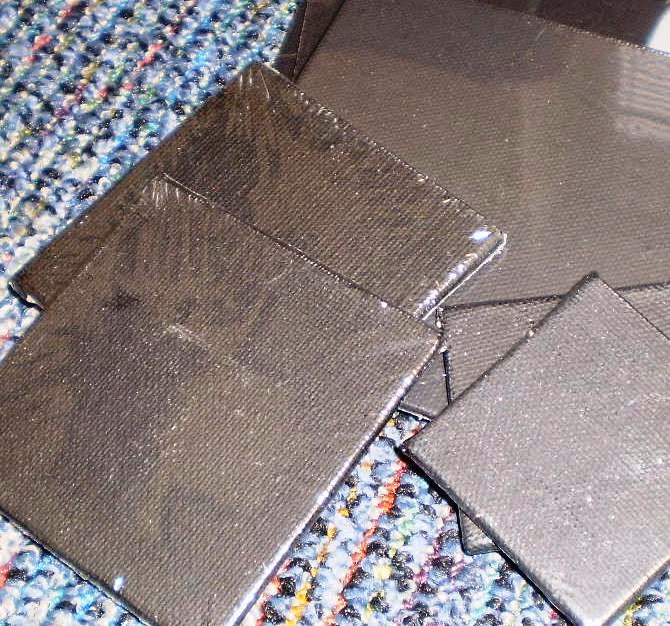
Canvas
If you're interested in creating visual/art objects, particularly with paint, canvas is a cool tool. I have both black and white canvases, in several dimensions, available; please stop by and collect one or two if you're interested in doing this kind of work for the vending machine.

 If you're interested in white canvas panels, I have several options: 5x7 in., 4x4 in., 3x3 in., and 2x2 in. Each are medium texture surfaces of archival, acid-free quality and are titanium acrylic gesso primed.

The black canvas panels are a tad more limited in size: these I only have in 4x4 in., 3x3 in., and 2x2 in. dimensions. Like the white canvases, each are medium texture surfaces of archival, acid-free quality and are titanium acrylic gesso primed.


Artist Tiles


If you incline toward drawing, charcoals, or the like, I have some artist titles (4x4 in. sheets) in two different textures: vellum surface tiles and cold press watercolor tiles. Acid free.


If there are other kinds of supplies that you'd like to have made available for your vending machine item creation needs, don't hesitate to let me (Dr. Renzi) know; I'll see what I can do to supply them for you! As the project moves forward, look for more information (blog entries and supply wise) for bookbinding you might use for artist books and/or other kinds of more intricate book and/or object creation projects!

When you say the possibilities are pretty open....

Look, I've been working for years with students, friends, and peers. Many start out saying that they aren't creative and/or don't have many interesting ideas for the production of material objects. They're usually flat-out wrong about this...and I have the material evidence in my office and in my home to prove this!

What kinds of book-like objects have folks I know created over the years? A diverse range of items...but for a quick visual sampler of items produced by my former students that you might consider using as jumping off points for your own work, see below:

This text  (to your left) was created as a satirical zine about xenophobia by a student in a Feminist Theory course I taught at MSU, and it draws from course texts, as well as outside research, to articulate its pro-diversity message.


All three of these texts were created by students in a course on Methodologies of Literary History with a focus on Genre that I taught at MSU. I Want the Ocean Right Now reads like a traditional book; Farm girl opens up like a map and can be read in frames like a comic, and The Age of Data: The Death of a CD can be read in booklet form as well as listened to.

This booklet is a collaboratively-produced class text from an Introduction to Creative Writing course taught at MSU, in which each student contributed the first image/idea that came into his or her head when I said the word “love”. Students later used this as a guide to help them depict abstract concepts more concretely in their creative writing.


This text, collectively produced by a Drama and Performance Studies class I taught at MSU, is a series of “Calling Cards” based off of the work of philosopher and artist Adrian Piper (in which she created cards to hand out in conversation as commentaries and correctives to assumption-based discourse about issues of diversity and oppression); my students used this project to help them understand the dimensions of performance that are present in their everyday lives, as well as its import.


These three texts were produced by members of my Fall 2013 ENGL 205: Lit and the Moral Imagination courses (focused around Guilt, Forgiveness, and Atonement). They are “manifestos” in which the students were asked to express their own changed and deepened understanding of guilt, forgiveness, and/or atonement based on our course texts and conversations. The one entitled “My Manifesto” is actually a painting done on canvas; the other two are posters. 


Finally, this is an artist's book created by a student of mine from the same Methodologies of Literary History: Genre course mentioned above. The book, My name is, tackles issues of identity in complex, moving, and critically adventurous ways. I've included the text of the book's first page, to give a sense of what you'd encounter upon opening this volume.


So really--when I say the possibilities are open, I pretty much mean it! Get creating!!

Guess What, XU? We have a community book/art vending machine!


I know what you may be thinking. You may be thinking what I might be thinking were I to hear about such a project occurring on a campus nearby: "Cool. But...what?" But rest assured, friends--this is going to be fun!

Below, I've included some anticipatory FAQs, along with my responses; however, let me know what further FAQs you have (for real!) and I can also address those in this blog space. But for now, let's get started:


What is a Book/Art Vending Machine?

Simply put, a book/art vending machine is a converted vending machine (ours is a converted snack machine) through which we can distribute Xavier community-created material objects such as zines, artist books, works of art, comics, maps, and pamphlets. I see the vending machine as a venue for XU faculty, staff, and students to apply theoretical and critical concepts in a format that encourages mastery of material, communicative excellence, openness to others’ views and opinions, and rigorous interdisciplinary, co-curricular dialogue, while also promoting the development and value of each student’s individual voice, aesthetic, and intellectual perspective. In short, it's a space for you to make your voice heard, and through which you can hear other community members' voices.

Where is the Book/Art Vending Machine located?

Our machine is currently being housed in the intersection between the Xavier University library 3rd floor and the Conaton Learning Common.

What kinds of things will go in our Book/Art Vending Machine?

Community-generated material objects could take many forms, including but not limited to zines, artist-books, pamphlets, photography, paintings, comics, maps, small art objects, and drawings. These materials could be created within the classroom setting as well as without, by groups and individuals. Free speech and freedom of expression are welcome and respected; however, hate speech (and its visual correlates) will not be tolerated and will be excluded from the machine. Otherwise, the possibilities are pretty open--visit the machine (on the 3rd floor of the library, right as you enter into the CLC) to get a sense of the size of individual dispensing racks (think: bag of chips and/or candy bar sizes). And you can make one-of-a-kind items or small runs/series--it's up to you! Items will be packaged in clear archival plastic with cardboard backing so that they vend properly.

How much do the items cost?

Items will be priced so that they are fairly inexpensive and easily accessible: right now, the highest priced item is $5.00 and the lowest pricing option is free!

How do I buy an item?

The same way you buy items via traditional vending machines--you can enter bills, coins, or use your ALL card.

What happens to the money the machine makes?

As we are getting the machine up and running, some of the initial machine profits will be set aside to cover the costs of future machine maintenance/replacement parts, etc. Additional profits will cover 1. the cost of the archival plastic bags/cardboard that is necessary for proper vending of the items and 2. supplies and materials that interested community members can use to produce vending items. Currently, there are no plans to pay vending machine item contributors, though this may change depending on machine popularity.

When can I start submitting materials for the machine?

Right now! ASAP! Aren't you already doing this?!?! Check out the "Interested in Submitting Material" sidebar for the printable (pdf-format) submission form, and then drop the form + item(s) off at Dr. Kristen Renzi's Hinkle Hall office or address to her mail location (4446). 

When can I start purchasing materials from the machine?

I'm hoping VERY soon. But that kind of depends on you all, too. Get making, creating, and vocalizing--the venue is here. Now we just need your voices!

Looking forward,


Dr. Renzi


The Book/Art Vending Machine (stage one)
Coils: ready and waiting to receive your awesome vocalizations!